


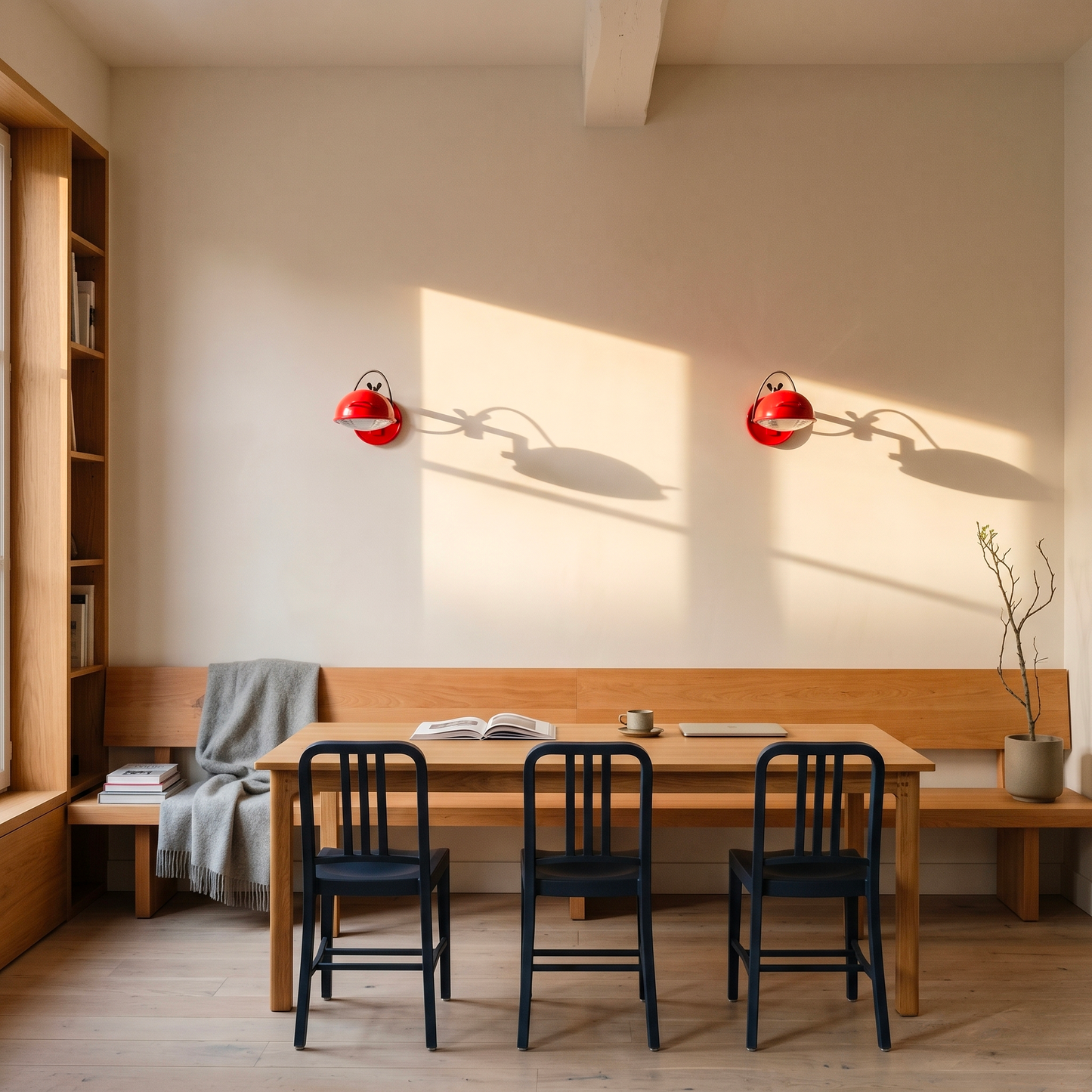


An Italian classic returns
The Jeep was designed in 1969 by Cesare Leonardi and Franca Stagi for the Italian manufacturer Lumenform in Scorzè. More than fifty years on, its form hasn't aged a day — an aluminium cylinder, a Fresnel lens, a visible articulating mechanism. Not a decorative detail: every element is structural.
Antifer reissues the Jeep faithful to the original drawing, with today's materials and finishes. It isn't a nostalgic reproduction — it's an object that has crossed the decades because its formal logic still holds true.

Wall light
Mounted on the wall, it becomes a directional light — hallway, headboard, reading nook.

Fresnel lens
The optical heart of the Jeep is a Fresnel lens — the same principle as maritime lighthouses. The lens concentrates the light into a wide, even beam, without glare. The light is gentle on the eyes yet directional enough to read, work or wash a wall.
The manual articulation lets you aim the beam. Butterfly nuts and compression springs hold it firmly in the chosen position — the lamp stays exactly where you set it.
Adjustable to the last degree
The wing nut releases the articulation axis. The reflector pivots freely, holds its position. A mechanism conceived in 1969 — still the most direct way to direct a beam of light exactly where it belongs.

Cesare Leonardi & Franca Stagi
Cesare Leonardi (1935–2021) and Franca Stagi (1937–2008) founded their studio in Modena in 1963. Over twenty years, they produced some of the most radical pieces of Italian design — the Nastro (Ribbon) chair, the Dondolo rocker, the Jeep lamp.
Their principle: every structural element is part of the design. No covers, no cladding, nothing concealed. What holds the object together is what gives it its shape. Their works are held at MoMA in New York, the Victoria and Albert Museum in London and the Vitra Design Museum.
See it from every angle
More than fifty years after it was drawn, the Jeep reveals its formal logic from every angle: aluminium cylinder, Fresnel lens, visible articulation. Nothing decorative — every element is structural.

Aluminium body
The Jeep's body is entirely aluminium — light, sturdy, recyclable. The hinges, butterfly nuts and compression springs are exposed and functional.
This is the Leonardi & Stagi philosophy at its most legible: show the construction rather than hide it. The finish is refined — matte powder-coat in earth red or midnight blue — but it dresses up nothing. It protects what is already beautiful by its own logic.

At home, in its light
As a wall light, it transforms a hallway, a landing or a headboard. On its own or in a row, in earth red or midnight blue — each configuration tells a different story.


