
-
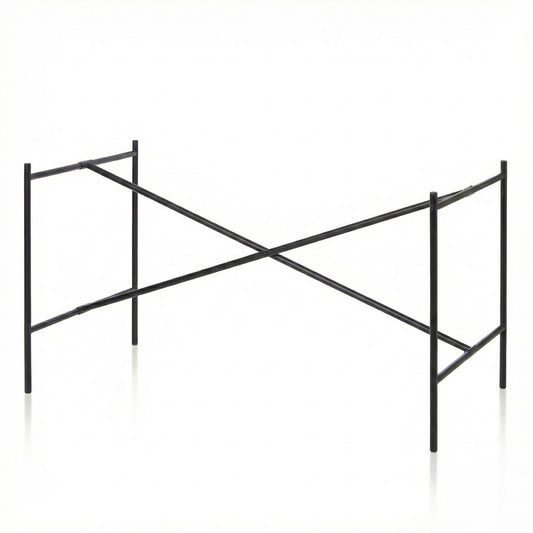
E2 Adjustable Table Base — Steel, 75-102 cm
Regular price From 235 €Regular price -
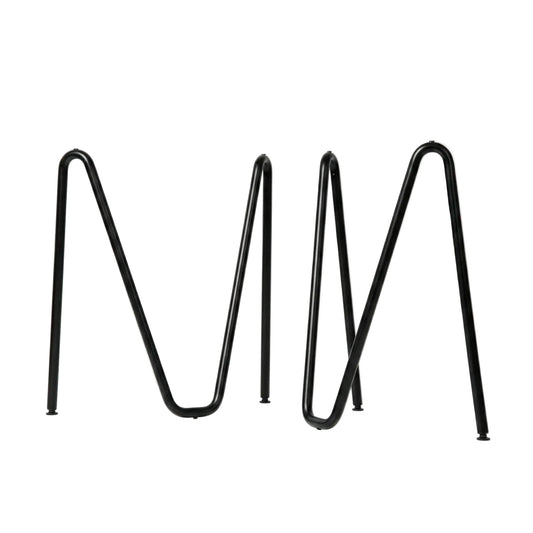
Sinus Trestles — Steel, Pair
Regular price 259 €Regular price -
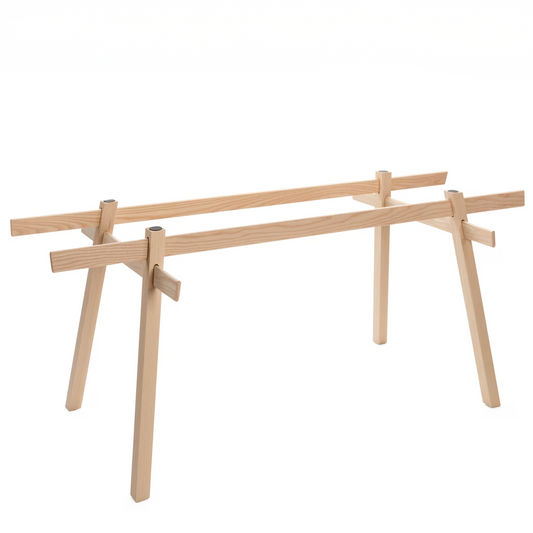
Stand Solid Ash Trestles — Jakob Timpe. 4 Legs No Screw
Regular price From 445 €Regular price -
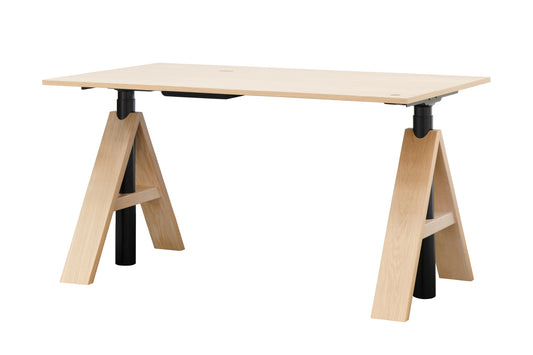
A-Frame Trestle Desk — Anderssen & Voll for Hörreds
Regular price From 2 114 €Regular price





The E2, from the Eiermann workshop to the Wielands
In 1953, architect Egon Eiermann designed for his own workshop in Karlsruhe a working trestle in welded steel tubes. In 1965, an assistant asked Adam Wieland, metalworker at the Karlsruhe Technical University, to make it transportable.
Wieland reinvented the system into four bolt-on elements with vertical crosses for stability. The base became dismountable, stackable, adaptable — named E2 in homage to Eiermann. Since 1965, the Wieland family has been making it in their workshops; today led by Peter Wieland, son of Adam.

Three systems, three uses
The E2 remains the reference for composing your own table: choose your top — oak, ash, linoleum, marble, laminate — and bolt on the four legs in minutes. Sinus trestles by Daniel Lorch, in powder-coated steel, offer a graphic solution for a desk or side table, with a curve that distributes the load.
The Stand in solid ash brings an all-wood base, more residential. The A-Frame desk, designed by Norwegian Anderssen & Voll for Hörreds, is a finished product rather than a base.
Order from a selective reseller
Frequently asked questions
Building your own table isn't reserved for architects. The principle: choose a base, choose a top, assemble. No special hardware, no carpentry skills required.
Four options. The Sinus trestles (Daniel Lorch), bent steel tube, sold in pairs — visually light, stackable. The Stand trestles (Jakob Timpe) in solid ash — four legs, four cross-pieces, no screws (the top's weight creates the tension). The E2 base (Adam Wieland), reinterpretation of the 1953 Eiermann trestle, dismountable and adjustable to any size. The A-Frame trestle (Anderssen & Voll for Hörreds) in solid Scandinavian wood, fixed or height-adjustable version.
To choose well, start from the top (size, weight) and the room. See also our custom and ready-made tops. Pro tariff on request.
Is the E2 leg the official edition?
Yes. The E2 has been made by the Wieland family in Karlsruhe since 1965, based on the system developed by Adam Wieland from the trestle drawn by Egon Eiermann in 1953. The company is now run by Peter Wieland, Adam's son.
Does the E2 leg come with a top?
No. The E2 is a leg system sold on its own. The top is the customer's choice — solid wood, linoleum on plywood, marble, tempered glass, laminate. For atypical tops, we work with a network of partner suppliers on a quote basis.
How to choose between E2, Sinus and Stand?
E2 if you want a demountable base, adaptable to any top size and visually discreet. Sinus if you are after a graphic signature and a quick trestle setup. Stand if you favour solid wood in a residential context.
What load and what top dimensions?
A well-sized system supports a 40 kg top and 100 kg of use load. For a table over 200 cm or a natural-stone top, move to six legs or fit reinforced connectors. Adjustable glides are supplied to compensate for uneven floors.
What are the delivery times?
Standard lead time: 2 to 3 weeks for most models. Exact lead time shown on each product page.