Kvadrat Really Recycled Table Top — Circular Textile
Couldn't load pickup availability
Recycled-textile tabletop
A tabletop that redefines the standards of circular design. Kvadrat Really's Textile Tabletop™ turns textile waste into a high-performance table surface, with no water, no dye, no chemicals.
A noble material with a warm feel
Against the grain of cold, smooth surfaces, this top offers a warm, slightly textured touch. The compressed textile material creates a unique tactile feel — soft yet non-porous, dense yet not rigid. A living surface that invites contact, particularly enjoyable in workspaces or family meals.
Invisible resilience
Don't be fooled by its apparent softness: this top achieves a 5 EN 12720+A1 rating — the maximum resistance to scratches, heat and liquids. The extreme compression of textile fibres creates a near-impermeable surface. A spilled glass? A simple wipe is enough. Common stains (coffee, wine, oil) wipe off without trace. This performance comes from the density of the material: unlike a classic fabric, the compacted surface doesn't absorb liquids.
A revolutionary material
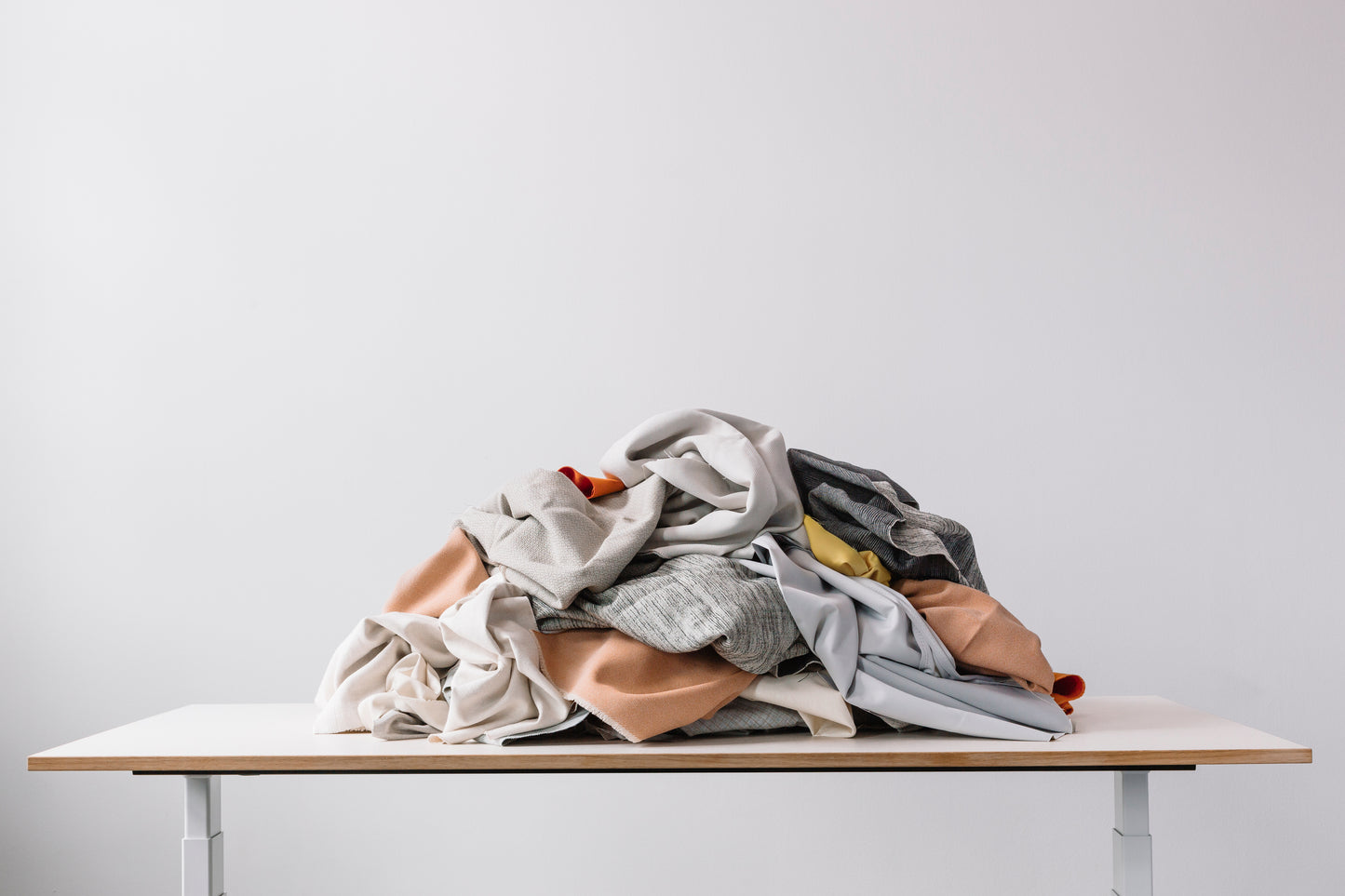
Each top is made of 70 % recycled textiles — cotton and wool from the fashion industry, laundries and Kvadrat production offcuts — and 30 % recycled binder. The Danish manufacturing process, powered by renewable energy, creates a dense, homogeneous material of exceptional resilience.
Natural, evolving design
Each top features natural tonal variations due to the multiple origins of the recycled textiles. These nuances, far from being a defect, signal the authenticity and uniqueness of each piece. The colours come from the textile-waste blend, with no added dye. A surface that improves with use, developing a subtle patina over time.
Pair this top with our design table bases: Sinus trestles, E2 base or Stand trestles in ash. Configure your custom table.

When worn textile becomes a noble material
Worldwide, 95 % of textiles are technically recyclable — only 25 % actually are. Since 2013, the Danish manufacturer Kvadrat Really has set itself a mission: turn this wasted resource into high-end technical materials. The Textile Tabletop™ was born of this ambition. A tabletop made of 70 % end-of-life textile fibres — essentially used cotton from fashion-industry offcuts and hospital linen — and 30 % of an equally recycled binder. No PVC, no melamine, no pressed wood: a fully circular material, conceived to be dismantled in turn and reintegrated into a new cycle.
Made in Denmark
Each shade of Textile Tabletop™ is a blend of existing textiles, never dyed. Kvadrat Really applies a strict no-dyestuff scheme: colour comes exclusively from the nature of the collected scraps. Four shades make up the range — Cotton White, Cotton Cream, Cotton Grey, Cotton Blue — with, from one batch to another, subtle variations of tone and a random fibre dispersion that make each tabletop a unique piece. This visual signature is not a defect: it is the visible proof of a production without chromatic additive, without extra energy expense, without dye discharge into wastewater.
Four shades, two thicknesses, four edge finishes
Each Textile Tabletop™ can be configured to use.
Shades — Cotton White · Cotton Cream · Cotton Grey · Cotton Blue Thicknesses — 18 mm (standard) · 22 mm (intensive use) Edge finishes — Raw edge (no edge, lets the felted material show) · ABS edge (matching colour) · Solid oak edge (natural counterpoint) · Clear-lacquered edge (makes the circularity visible)
Standard dimensions — rectangular 800 × 1200 / 1400 / 1600 / 1800 mm · round Ø 500 / 800 / 1100 mm. Custom formats available on request.
The circular benefit in figures
-
70 % recycled fibres
Cotton and wool from fashion-industry offcuts, hospital linen and Kvadrat production scraps. 30 % of an equally recycled binder. No PVC, no melamine, no pressed wood.
-
0 dye, 0 water discharge
No-dyestuff scheme process: colour comes exclusively from the recycled raw material. No dye, no extra energy expense, no dye discharge into wastewater.
-
7.5 kg CO₂eq / m²
Five times less than ceramic. Density 2,200 to 2,400 kg/m³, close to natural stone. Dismantlable and reintegrable into a new cycle at end of life.